

Photos: Adrian Lück
Remembrance as the Highest Form of Forgetting
Act I – Lecture by Felicitas Kübler and performance by Angelika Waniek
21 November 2024, 6 pm / Oberlichtsaal, Leipzig City Library
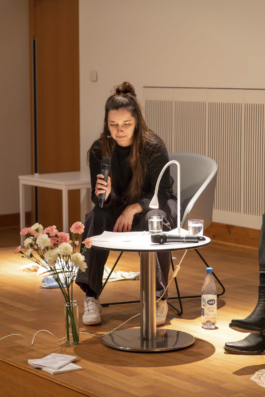
Lecture by Felicitas Kübler:
On Shedding and Experiencing the Past: A Contradictory Model of Commemoration
Performance by Angelika Waniek:
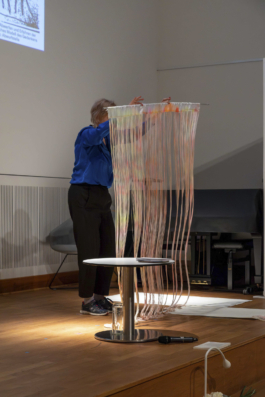
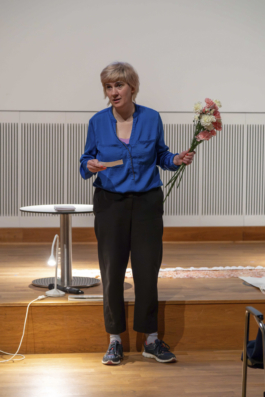
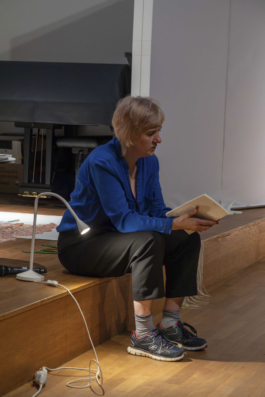
Abwurfstelle
Moderation and discussion: Nanne Buurman
The lecture On Shedding and Experiencing the Past: A Contradictory Model of Commemoration by Felicitas Kübler explores different forms of commemorative culture. She analyses “empty” forms of remembrance as phenomena of capitalist social relations and outlines proposals for a practice of remembrance as a means of contemporary social critique. In her performance Abwurfstelle, Angelika Waniek uses narrative strategies to question such a ritual of remembrance emptied of meaning.
The event marks the first act of the multi-part exhibition project Remembrance as the Highest Form of Forgetting by artist Ute Richter, developed in collaboration with Angelika Waniek and curated by Kunstraum IDEAL. The project creates space for artistic processes engaging with the politics of memory and provides a forum for reflecting on historical and contemporary forms of public remembrance and questioning their symbolism.
Felicitas Kübler
On Shedding and Experiencing the Past: A Contradictory Model of Commemoration
Individual acts of remembering are central to our lives. In Western societies in particular, we have been speaking of a memory boom for several years. New monuments are being built, museums opened and commemorative events held. Whether relating to National Socialism, Germany’s colonial past or the division of the country, we are confronted with an extraordinary range of literary, artistic, educational and material testimonies to the past. Yet these testimonies do not merely seek to refer symbolically to history; they are also expected to have social and political relevance in the present. The past is framed as a warning against repetition – particularly in relation to the memory of National Socialism. This aspiration is being radically called into question by the growing social acceptability of far-right discourse, increasing support for far-right parties and policies, and, not least, far-right violence. At the same time, memorial sites risk becoming places of empty symbolic politics – a tendency captured in the critically sardonic term Kranzabwurfstelle, literally a place where wreaths are dropped off.
Taking this problem as its starting point, the lecture develops a dialectical perspective on the ambivalent functioning of sites of remembrance. Felicitas Kübler proposes understanding sites of collective memory as social phenomena embedded in capitalist relations, which commodify all aspects of social life. Consequently, remembrance itself is shaped by capitalist logics such as abstraction and the principle of exchange. At the same time, memories and their material manifestations can also provide spaces for an emphatic engagement with the past, its presence in the present and the act of remembrance. In this moment, they acquire a critical social function, through which they can evade capitalist forms and the conditions that sustain them. Against the backdrop of these theoretical considerations, an urgent question arises: Why does it seem that we have learned so little from the past, and what possibilities might commemorative culture open up for breaking these patterns in the future?
The three-part exhibition project was developed through close collaboration between Ute Richter, Angelika Waniek, Clara Hofmann and Gregor Peschko. The project’s graphic design and banner were created in collaboration with graphic designers Nelly Nakahara and Gerrit Brocks.
Supported by the Cultural Foundation of the Free State of Saxony, the Cultural Office of the City of Leipzig, the Stiftung Kunstfonds, the Federal Government Commissioner for Culture and the Media, and the Saxon funding programme Sehnsucht nach Freiheit. This measure is co-financed by tax revenue on the basis of the budget adopted by the Saxon State Parliament.