Erinnerung als höchste Form des Vergessens
AKT III – Exhibition and Program
1. March – 30. April 2025
Exhibition with Ute Richter and a performance von Angelika Waniek contributions by Max Baitinger, Mandy Gehrt, Juliane Jaschnow, Susanne Keichel and Ipke Starke as well as Slacknetz Leipzig e.V.
->Documentation Program
Exhibition:
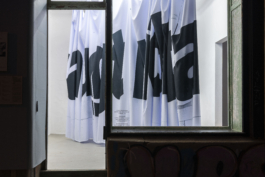
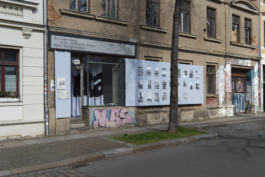
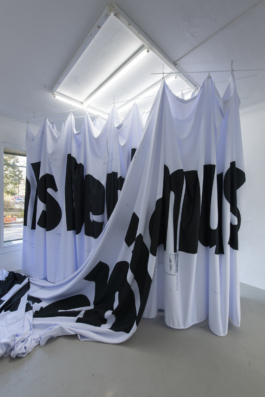
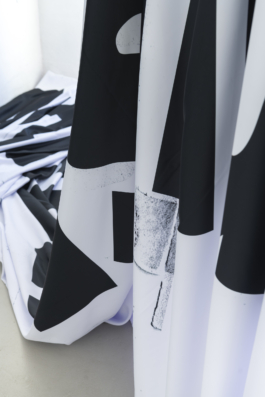
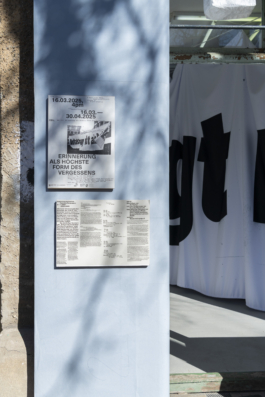
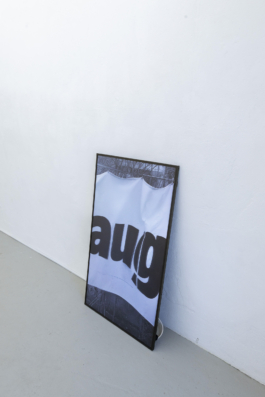
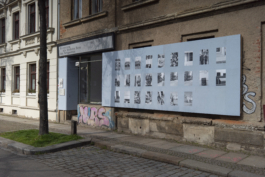
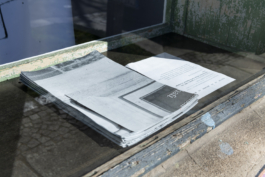
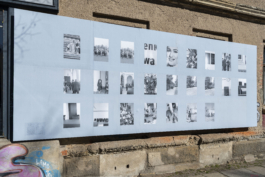
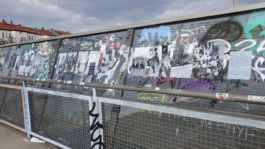
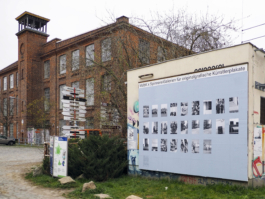
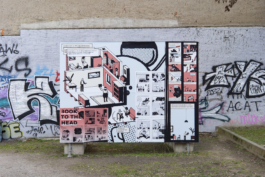

Photos: Anna Sophie Knobloch
Act I – Lecture: Felicitas Kübler "Vom Abwerfen und Erfahren der Vergangenheit: Ein widersprüchliches Modell des Gedenkens" ("On Shedding and Experiencing the Past: A Contradictory Model of Commemoration") Moderation: Nanne Buurman Performance: Angelika Waniek "Abwurfstelle: Many happy returns" ("Drop Zone: Many happy returns") November 2024, Leipzig Public Library (Stadtbibliothek Leipzig)
ACT II Intervention / Banner Performance: Ute Richter and Angelika Waniek with Slacknetz Leipzig e.V. January 2025, public space in front of the Stelzenhaus industrial monument in Leipzig-Plagwitz.
Dates:
March 16
4:00 PM: Exhibition opening at IDEAL
4:30 PM: Performance by Angelika Waniek and Inga Martel
April 5
2:00 PM: Neighborhood guided tour of the Stelzenhaus by the Memorial for Forced Labor (Gedenkstätte für Zwangsarbeit)
April 24
5:00 PM: Performance by Angelika Waniek and Inga Martel in cooperation with the exhibition "Partizan★ke Art" at the HGB Leipzig (Academy of Fine Arts Leipzig)
April 26
6:00 PM: Artist talk with Mandy Gehrt at Pöge-Haus
April 30
7:00 PM: Discussion with the curators and participating artists at IDEAL
->Dokumentation Programm
Works in the Exhibition:
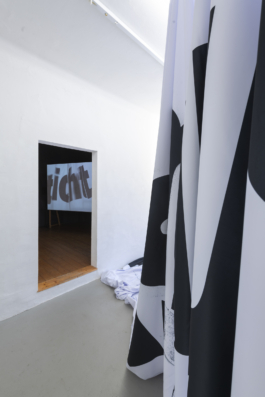
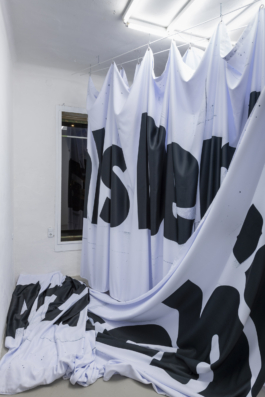
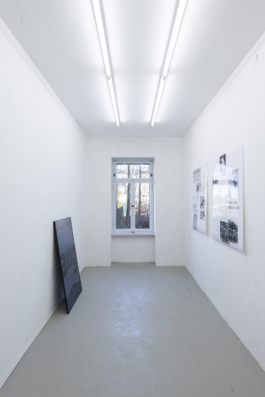
Spatial Installation – Erinnerung als höchste Form des Vergessens
Ute Richter in collaboration with Juliane Jaschnow and Ipke Starke
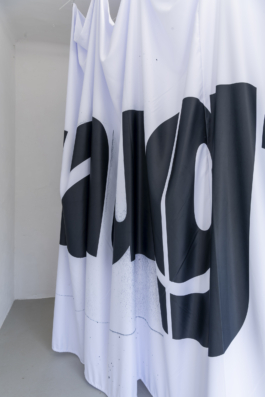
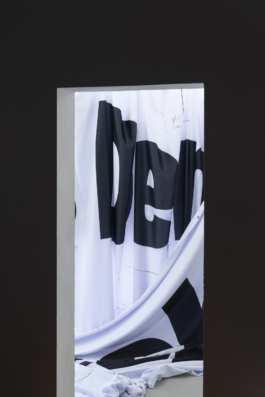
Banner, Antifaschismus taugt nicht als Denkmal , 30 x 3 m
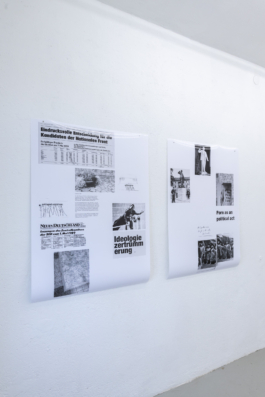
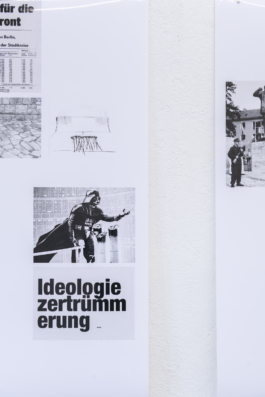
Material, A0 Prints, 2020–24
Drawings from the series "liegen" ("lying"), 2023
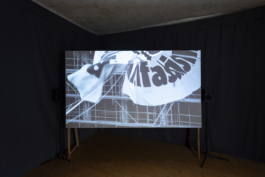
Video I / Juliane Jaschnow Video projection, HD, 5′34″, loop Camera and editing: Juliane Jaschnow 1st Camera: Clara Wieck
Sound / Ipke Starke Stereo, 5′34″, loop
Video II / Juliane Jaschnow Monitor, reading loop, 4K, 1′49″
Banner Performance, January 2025 Intervention at the Stelzenhaus Leipzig-Plagwitz by Ute Richter and Angelika Waniek in cooperation with Slacknetz Leipzig e.V.
What can a culture of remembrance look like that does not rigidify into ritualized gestures to follow prescribed municipal, state, or political protocols, and that does not generate wreath-laying ceremonies and memorial plaques? A question of urban and cultural practice. The assertion "Antifaschismus taugt nicht als Denkmal" ("Anti-fascism is no good as a monument") emerged while listening to a radio broadcast about the work of the Jewish poet Paul Celan, which is shaped by his direct experience of violence, persecution, and death under fascism. It is a dialectical perspective on a contemporary culture of commemoration that produces media-effective images with representative gestures on official days of remembrance.
The expansive banner visually quotes the official political slogans of the GDR in public space, which propagated a politically sanctioned anti-fascism on oversized banners. In terms of content, the slogan addresses the contradictions of the politics of memory in its ambivalence. The sentence on the 30-meter-long banner is set in the typeface Super Grotesk. Designed in 1928 by Arno Drescher—who was also rector of the Leipzig Academy of Visual Arts from 1940 to 1945—Super Grotesk, alongside Maxima, was one of the most frequently used typefaces in the GDR. In "Neues Deutschland"—the "Central Organ of the SED" from 1946 to 1989—it was used to set the daily political slogans of real existing socialism.
The public space above the Karl-Heine-Kanal at the Stelzenhaus in the former industrial district of Leipzig-Plagwitz is used by Slacknetz Leipzig e.V. for balancing acts. On weekends, one can watch the slackliners train there and marvel at their feats. This urban practice of playfully utilizing city space also holds entertainment value for passersby. The activation of the banner in this context breaks with the gestures of demonstrations and political demands, gaining momentum through the acrobatic lightness of the movements on the slackline.
As an industrial monument, the Stelzenhaus itself is also a memorial site for forced labor during the Nazi era. To expand capacities for armaments production at the Grohmann & Frosch galvanizing plant, a new hall was needed in the Leipzig-Plagwitz industrial area. Due to a lack of space, the warehouse built on stilts along the excavated Karl-Heine-Kanal was constructed between 1937 and 1939. During World War II, the company produced, among other things, the "Siegfried" tank shield, deploying forced laborers and prisoners of war for production. The eponymous quote by historian Eike Geisel comments on forms of commemoration in Germany as the "highest form of forgetting" and addresses the contradictions and instrumentalizations of the culture of remembrance.
aufknoten/aufmerken, sich wieder verbinden (unknotting/taking notice, reconnecting) Angelika Waniek and Inga Martel Performance / March 16 + April 24
aufknoten/aufmerken, sich wieder verbinden is an investigation into contemporary witness testimony (Zeitzeugenschaft) in public space—a performative situation in the neighborhood of plants. In it, performer Angelika Waniek, together with artist and somatic researcher Inga Martel, looks at individual life stories, subjective experiences, plants, and their traces. The era being testified to is that of National Socialism. The witnesses are those against whom the violence of National Socialism was directed, as well as trees as supposedly silent witnesses to whom Waniek and Martel turn their attention. Two of these trees stand in the immediate vicinity of the IDEAL art space and the Academy of Fine Arts Leipzig (HGB)—places to which the artists are connected.
March 16 // 4:30 PM, IDEAL Art Space aufknoten, sich wieder verbinden (unknotting, reconnecting) The IDEAL art space is located on the former factory grounds of the company Clemens Humann, a metal factory that operated as a supplier for the armaments industry during World War II, particularly for aircraft construction. Forced laborers were deployed there, primarily from the Soviet Union, France, Spain, Estonia, Belgium, Italy, Croatia, and the Protectorate of Bohemia and Moravia. Source: Memorial for Forced Labor Leipzig (www.zwangsarbeit-in-leipzig.de/karte)
April 24 // 5:00 PM, Academy of Fine Arts Leipzig (HGB) aufmerken, sich wieder verbinden (taking notice, reconnecting) The performance near the HGB takes place in cooperation with the exhibition "Partizan★ke Art – The Art of Female Resistance in Yugoslavia and Carinthia", which focuses on the still largely invisible female resistance against German occupying forces and the Axis powers in Yugoslavia.
Book to head - Max Baitinger at the Billboard
Max Baitinger's comic is a narrative deconstruction of a few seconds in the life of Victor Klemperer: in Dresden, SS member Johannes Clemens strikes him on the head with the book The Myth of the Twentieth Century (Der Mythos des 20. Jahrhunderts). The symbolism of a Jewish professor being struck with Nazi ideology by an SS member is dismantled across the thirty pages of the comic. Baitinger follows narrative threads running through the protagonist's life to lend depth to a blunt yet poignant anecdote. For the IDEAL Art Space, the original 2017 booklet was rearranged into a billboard collage. Victor Klemperer (1881–1960) is known for his diaries chronicling his years under National Socialism, which he spent in Dresden with his non-Jewish wife, Eva.
geb. 7. Oktober 1977, Alexandria, gest. 1. Juli 2009, Dresden (ein Kommentar) (b. October 7, 1977, Alexandria, d. July 1, 2009, Dresden (a commentary)) - Susanne Keichel, Poster series in urban space
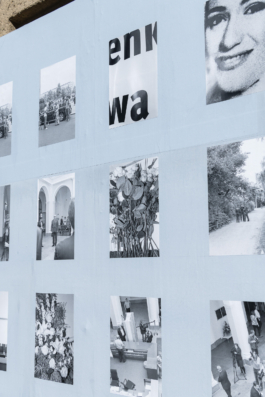
In this work, photographer Susanne Keichel shows the memorial services for the Egyptian woman Marwa Ali El-Sherbini from the perspective of an attendee. She was an Egyptian national handball player and pharmacist who, while serving as a witness in a criminal trial in Dresden in 2009, was stabbed to death in the courtroom by the defendant out of Islamophobic and xenophobic motives. The act of violence in the courtroom sparked a debate about courtroom security and a culture of remembrance for the victim in Dresden. Aesthetically, the snapshot-like framing moves between private photographs and press photos, serving as a reminder that this is not fiction. They document moments—a feeling of dismay and powerlessness in the face of an act that took place before everyone's eyes. The photographic work was adapted as a poster edition for this exhibition and is distributed throughout the urban space in addition to being presented at IDEAL.
Mapping a Memory Mandy Gehrt Talk on an artistic archive project / April 26
In her work, Mandy Gehrt engages with forms of remembering and preserving, cultures of commemoration, and the construction of history. She is interested in private collections and narratives as well as archiving practices and collective rituals of remembrance. With her artistic archive project, she aims to map the individual memories of Hungarian-Jewish Holocaust survivors who were conscripted for forced labor at the Buchenwald subcamp in Markkleeberg (Leipzig district).
In the talk, Mandy Gehrt will offer insights into her research in Germany, Hungary, and New York, during which she documented the survivors' life paths all the way to New York and examined connections to archives and museums. In this context, she also visited the survivors' families and explored their individual practices of remembrance.
Participants
The three-part exhibition project was developed through close collaboration between Ute Richter, Angelika Waniek, Clara Hofmann and Gregor Peschko. The project’s graphic design and banner were created in collaboration with graphic designers Nelly Nakahara and Gerrit Brocks.
Supported by the Cultural Foundation of the Free State of Saxony, the Cultural Office of the City of Leipzig, the Stiftung Kunstfonds, the Federal Government Commissioner for Culture and the Media, and the Saxon funding programme Sehnsucht nach Freiheit. This measure is co-financed by tax revenue on the basis of the budget adopted by the Saxon State Parliament.

Erinnerung als höchste Form des Vergessens
AKT III – Exhibition and Program
1. March – 30. April 2025
Exhibition with Ute Richter and a performance von Angelika Waniek contributions by Max Baitinger, Mandy Gehrt, Juliane Jaschnow, Susanne Keichel and Ipke Starke as well as Slacknetz Leipzig e.V.
->Documentation Program
Exhibition:
Photos: Anna Sophie Knobloch
Act I – Lecture: Felicitas Kübler "Vom Abwerfen und Erfahren der Vergangenheit: Ein widersprüchliches Modell des Gedenkens" ("On Shedding and Experiencing the Past: A Contradictory Model of Commemoration") Moderation: Nanne Buurman Performance: Angelika Waniek "Abwurfstelle: Many happy returns" ("Drop Zone: Many happy returns") November 2024, Leipzig Public Library (Stadtbibliothek Leipzig)
ACT II Intervention / Banner Performance: Ute Richter and Angelika Waniek with Slacknetz Leipzig e.V. January 2025, public space in front of the Stelzenhaus industrial monument in Leipzig-Plagwitz.
Dates:
March 16
4:00 PM: Exhibition opening at IDEAL
4:30 PM: Performance by Angelika Waniek and Inga Martel
April 5
2:00 PM: Neighborhood guided tour of the Stelzenhaus by the Memorial for Forced Labor (Gedenkstätte für Zwangsarbeit)
April 24
5:00 PM: Performance by Angelika Waniek and Inga Martel in cooperation with the exhibition "Partizan★ke Art" at the HGB Leipzig (Academy of Fine Arts Leipzig)
April 26
6:00 PM: Artist talk with Mandy Gehrt at Pöge-Haus
April 30
7:00 PM: Discussion with the curators and participating artists at IDEAL
->Dokumentation Programm
Works in the Exhibition:
Spatial Installation – Erinnerung als höchste Form des Vergessens
Ute Richter in collaboration with Juliane Jaschnow and Ipke Starke
Banner, Antifaschismus taugt nicht als Denkmal , 30 x 3 m
Material, A0 Prints, 2020–24
Drawings from the series "liegen" ("lying"), 2023
Video I / Juliane Jaschnow Video projection, HD, 5′34″, loop Camera and editing: Juliane Jaschnow 1st Camera: Clara Wieck
Sound / Ipke Starke Stereo, 5′34″, loop
Video II / Juliane Jaschnow Monitor, reading loop, 4K, 1′49″
Banner Performance, January 2025 Intervention at the Stelzenhaus Leipzig-Plagwitz by Ute Richter and Angelika Waniek in cooperation with Slacknetz Leipzig e.V.
What can a culture of remembrance look like that does not rigidify into ritualized gestures to follow prescribed municipal, state, or political protocols, and that does not generate wreath-laying ceremonies and memorial plaques? A question of urban and cultural practice. The assertion "Antifaschismus taugt nicht als Denkmal" ("Anti-fascism is no good as a monument") emerged while listening to a radio broadcast about the work of the Jewish poet Paul Celan, which is shaped by his direct experience of violence, persecution, and death under fascism. It is a dialectical perspective on a contemporary culture of commemoration that produces media-effective images with representative gestures on official days of remembrance.
The expansive banner visually quotes the official political slogans of the GDR in public space, which propagated a politically sanctioned anti-fascism on oversized banners. In terms of content, the slogan addresses the contradictions of the politics of memory in its ambivalence. The sentence on the 30-meter-long banner is set in the typeface Super Grotesk. Designed in 1928 by Arno Drescher—who was also rector of the Leipzig Academy of Visual Arts from 1940 to 1945—Super Grotesk, alongside Maxima, was one of the most frequently used typefaces in the GDR. In "Neues Deutschland"—the "Central Organ of the SED" from 1946 to 1989—it was used to set the daily political slogans of real existing socialism.
The public space above the Karl-Heine-Kanal at the Stelzenhaus in the former industrial district of Leipzig-Plagwitz is used by Slacknetz Leipzig e.V. for balancing acts. On weekends, one can watch the slackliners train there and marvel at their feats. This urban practice of playfully utilizing city space also holds entertainment value for passersby. The activation of the banner in this context breaks with the gestures of demonstrations and political demands, gaining momentum through the acrobatic lightness of the movements on the slackline.
As an industrial monument, the Stelzenhaus itself is also a memorial site for forced labor during the Nazi era. To expand capacities for armaments production at the Grohmann & Frosch galvanizing plant, a new hall was needed in the Leipzig-Plagwitz industrial area. Due to a lack of space, the warehouse built on stilts along the excavated Karl-Heine-Kanal was constructed between 1937 and 1939. During World War II, the company produced, among other things, the "Siegfried" tank shield, deploying forced laborers and prisoners of war for production. The eponymous quote by historian Eike Geisel comments on forms of commemoration in Germany as the "highest form of forgetting" and addresses the contradictions and instrumentalizations of the culture of remembrance.
aufknoten/aufmerken, sich wieder verbinden (unknotting/taking notice, reconnecting) Angelika Waniek and Inga Martel Performance / March 16 + April 24
aufknoten/aufmerken, sich wieder verbinden is an investigation into contemporary witness testimony (Zeitzeugenschaft) in public space—a performative situation in the neighborhood of plants. In it, performer Angelika Waniek, together with artist and somatic researcher Inga Martel, looks at individual life stories, subjective experiences, plants, and their traces. The era being testified to is that of National Socialism. The witnesses are those against whom the violence of National Socialism was directed, as well as trees as supposedly silent witnesses to whom Waniek and Martel turn their attention. Two of these trees stand in the immediate vicinity of the IDEAL art space and the Academy of Fine Arts Leipzig (HGB)—places to which the artists are connected.
March 16 // 4:30 PM, IDEAL Art Space aufknoten, sich wieder verbinden (unknotting, reconnecting) The IDEAL art space is located on the former factory grounds of the company Clemens Humann, a metal factory that operated as a supplier for the armaments industry during World War II, particularly for aircraft construction. Forced laborers were deployed there, primarily from the Soviet Union, France, Spain, Estonia, Belgium, Italy, Croatia, and the Protectorate of Bohemia and Moravia. Source: Memorial for Forced Labor Leipzig (www.zwangsarbeit-in-leipzig.de/karte)
April 24 // 5:00 PM, Academy of Fine Arts Leipzig (HGB) aufmerken, sich wieder verbinden (taking notice, reconnecting) The performance near the HGB takes place in cooperation with the exhibition "Partizan★ke Art – The Art of Female Resistance in Yugoslavia and Carinthia", which focuses on the still largely invisible female resistance against German occupying forces and the Axis powers in Yugoslavia.
Book to head - Max Baitinger at the Billboard
Max Baitinger's comic is a narrative deconstruction of a few seconds in the life of Victor Klemperer: in Dresden, SS member Johannes Clemens strikes him on the head with the book The Myth of the Twentieth Century (Der Mythos des 20. Jahrhunderts). The symbolism of a Jewish professor being struck with Nazi ideology by an SS member is dismantled across the thirty pages of the comic. Baitinger follows narrative threads running through the protagonist's life to lend depth to a blunt yet poignant anecdote. For the IDEAL Art Space, the original 2017 booklet was rearranged into a billboard collage. Victor Klemperer (1881–1960) is known for his diaries chronicling his years under National Socialism, which he spent in Dresden with his non-Jewish wife, Eva.
geb. 7. Oktober 1977, Alexandria, gest. 1. Juli 2009, Dresden (ein Kommentar) (b. October 7, 1977, Alexandria, d. July 1, 2009, Dresden (a commentary)) - Susanne Keichel, Poster series in urban space
In this work, photographer Susanne Keichel shows the memorial services for the Egyptian woman Marwa Ali El-Sherbini from the perspective of an attendee. She was an Egyptian national handball player and pharmacist who, while serving as a witness in a criminal trial in Dresden in 2009, was stabbed to death in the courtroom by the defendant out of Islamophobic and xenophobic motives. The act of violence in the courtroom sparked a debate about courtroom security and a culture of remembrance for the victim in Dresden. Aesthetically, the snapshot-like framing moves between private photographs and press photos, serving as a reminder that this is not fiction. They document moments—a feeling of dismay and powerlessness in the face of an act that took place before everyone's eyes. The photographic work was adapted as a poster edition for this exhibition and is distributed throughout the urban space in addition to being presented at IDEAL.
Mapping a Memory Mandy Gehrt Talk on an artistic archive project / April 26
In her work, Mandy Gehrt engages with forms of remembering and preserving, cultures of commemoration, and the construction of history. She is interested in private collections and narratives as well as archiving practices and collective rituals of remembrance. With her artistic archive project, she aims to map the individual memories of Hungarian-Jewish Holocaust survivors who were conscripted for forced labor at the Buchenwald subcamp in Markkleeberg (Leipzig district).
In the talk, Mandy Gehrt will offer insights into her research in Germany, Hungary, and New York, during which she documented the survivors' life paths all the way to New York and examined connections to archives and museums. In this context, she also visited the survivors' families and explored their individual practices of remembrance.
Participants
The three-part exhibition project was developed through close collaboration between Ute Richter, Angelika Waniek, Clara Hofmann and Gregor Peschko. The project’s graphic design and banner were created in collaboration with graphic designers Nelly Nakahara and Gerrit Brocks.
Supported by the Cultural Foundation of the Free State of Saxony, the Cultural Office of the City of Leipzig, the Stiftung Kunstfonds, the Federal Government Commissioner for Culture and the Media, and the Saxon funding programme Sehnsucht nach Freiheit. This measure is co-financed by tax revenue on the basis of the budget adopted by the Saxon State Parliament.